What makes an electric vehicle go? Here's a plain English guide to every component in an EV powertrain, battery, inverter, motor, reduction gear, thermal management, and how they work together
Pop the bonnet on an electric vehicle and you'll find something that looks almost disappointingly simple compared to a petrol engine. There's no complex arrangement of camshafts, timing chains, fuel injectors, or exhaust manifolds. What you will find, spread between the bonnet, the floor, and beneath the rear of the vehicle, is a set of components that are deceptively sophisticated and work together with a precision that petrol engines simply can't match.
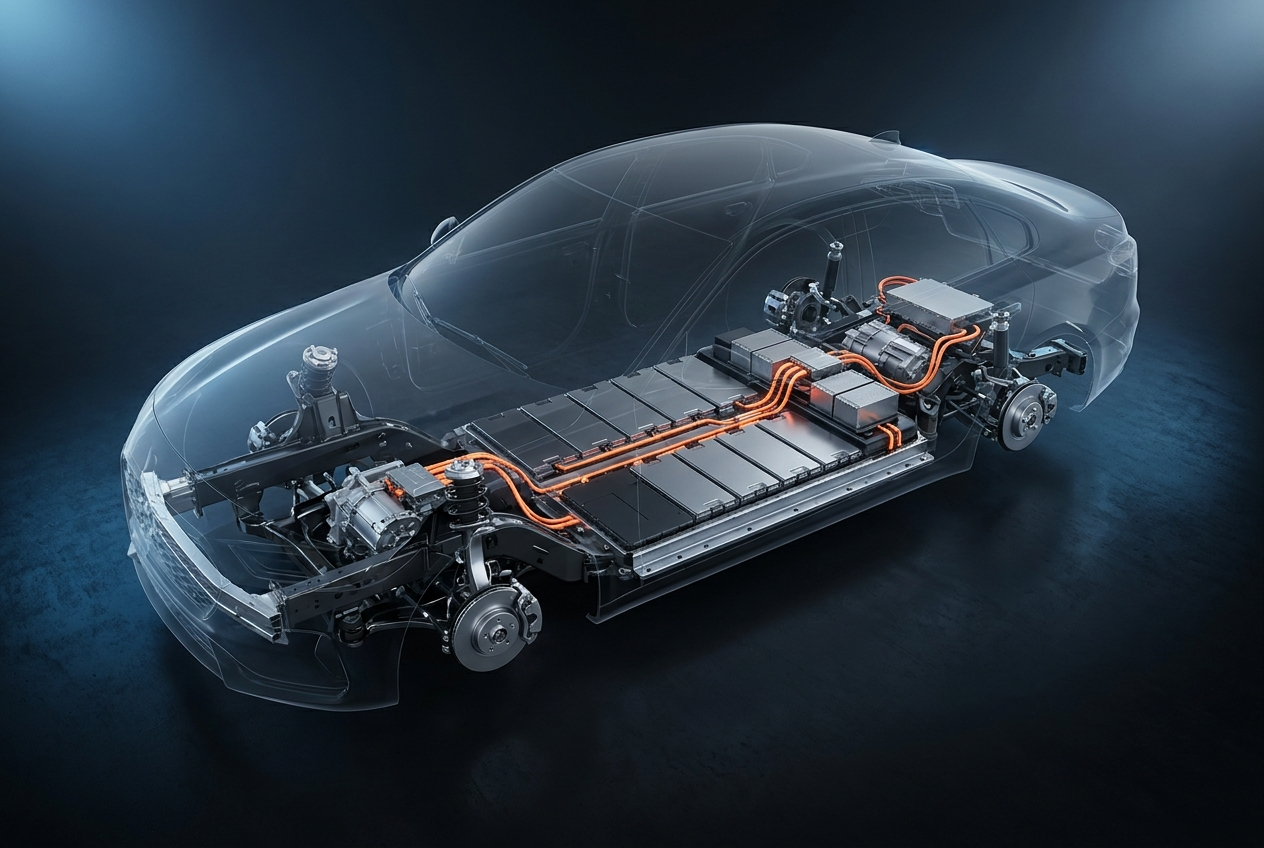
Here's what every major component in an EV powertrain does, how they connect, and why the whole system is so much more efficient than what came before it.
Powertrain vs drivetrain, what's the difference?
These two terms are often used interchangeably, but they describe different parts of the system.
The powertrain is the energy conversion chain, it takes stored energy and turns it into rotational force (torque). In an EV, the powertrain includes the battery, the inverter, the motor controller, and the electric motor.
The drivetrain is everything that takes that rotational force and delivers it to the road, the reduction gearbox, driveshafts, axles, and wheels.
Put simply: powertrain generates power and decides how to use it. Drivetrain moves that power where it counts, to the road. Both need to work seamlessly together for the vehicle to perform well.
Component 1: The high-voltage battery pack
The battery is the EV's fuel tank and energy store combined. Unlike a petrol tank that simply holds liquid fuel, the battery actively manages energy storage and delivery as a complex electrochemical system.
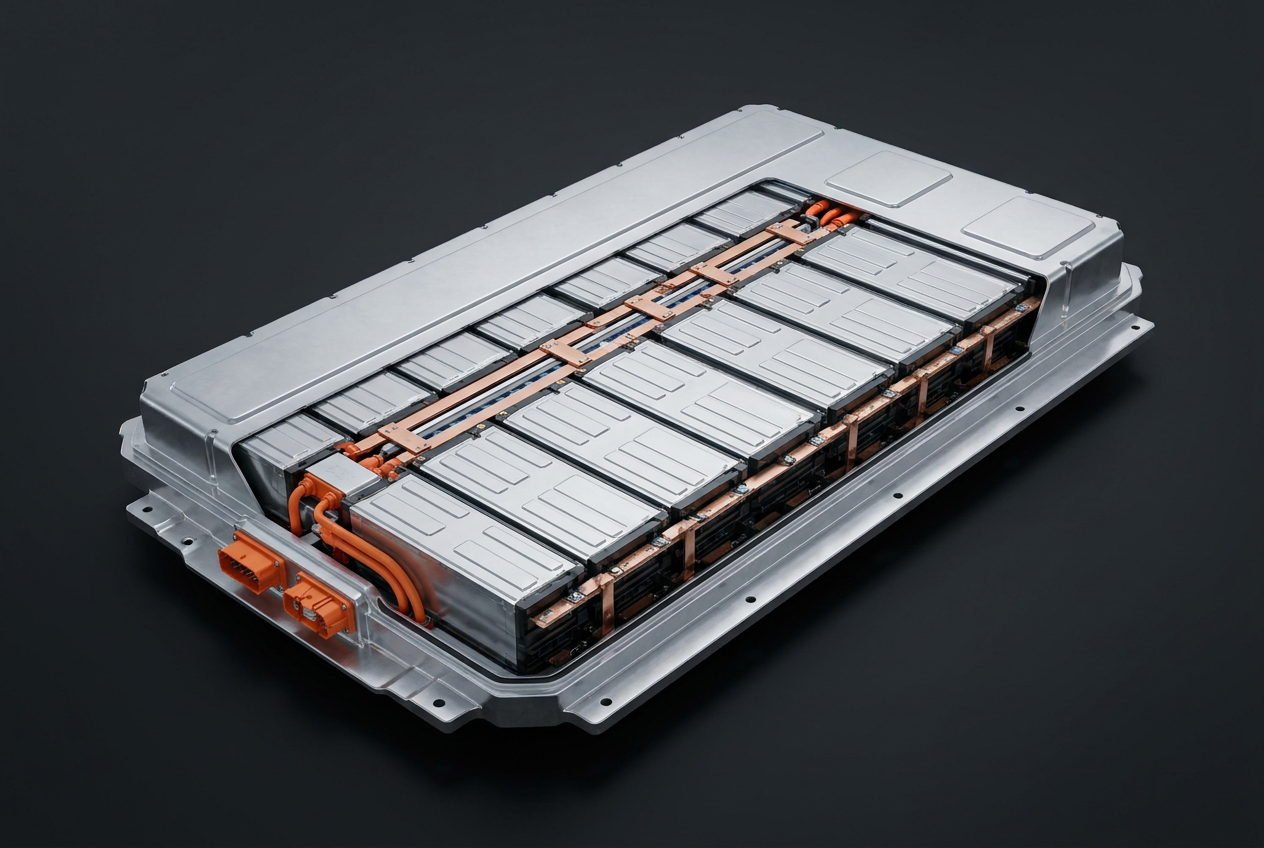
Modern EV battery packs are built in layers:
Cells are the fundamental building blocks, individual electrochemical units that store and release energy. A single cell typically produces 3.2–4.2 volts depending on its chemistry. One cell alone isn't enough to power a vehicle.
Modules are groups of cells connected together in series and parallel combinations to increase voltage and capacity. Most battery packs consist of multiple modules.
The pack is the complete assembly of modules, housed in a sealed, crash-resistant enclosure that typically forms part of the vehicle's floor structure, lowering the centre of gravity and improving handling in the process.
A typical EV battery pack operates at 300–800 volts. The trend toward 800V architecture, used by Hyundai's Ioniq 5 and 6, Kia EV6 and EV9, and Porsche Taycan, enables significantly faster DC charging because higher voltage allows more power to be transferred at lower current levels, reducing heat and enabling charge rates exceeding 200kW.
Component 2: The Battery Management System (BMS)
The BMS is the intelligence layer of the battery pack, a sophisticated electronic control unit that continuously monitors and manages every aspect of battery operation.
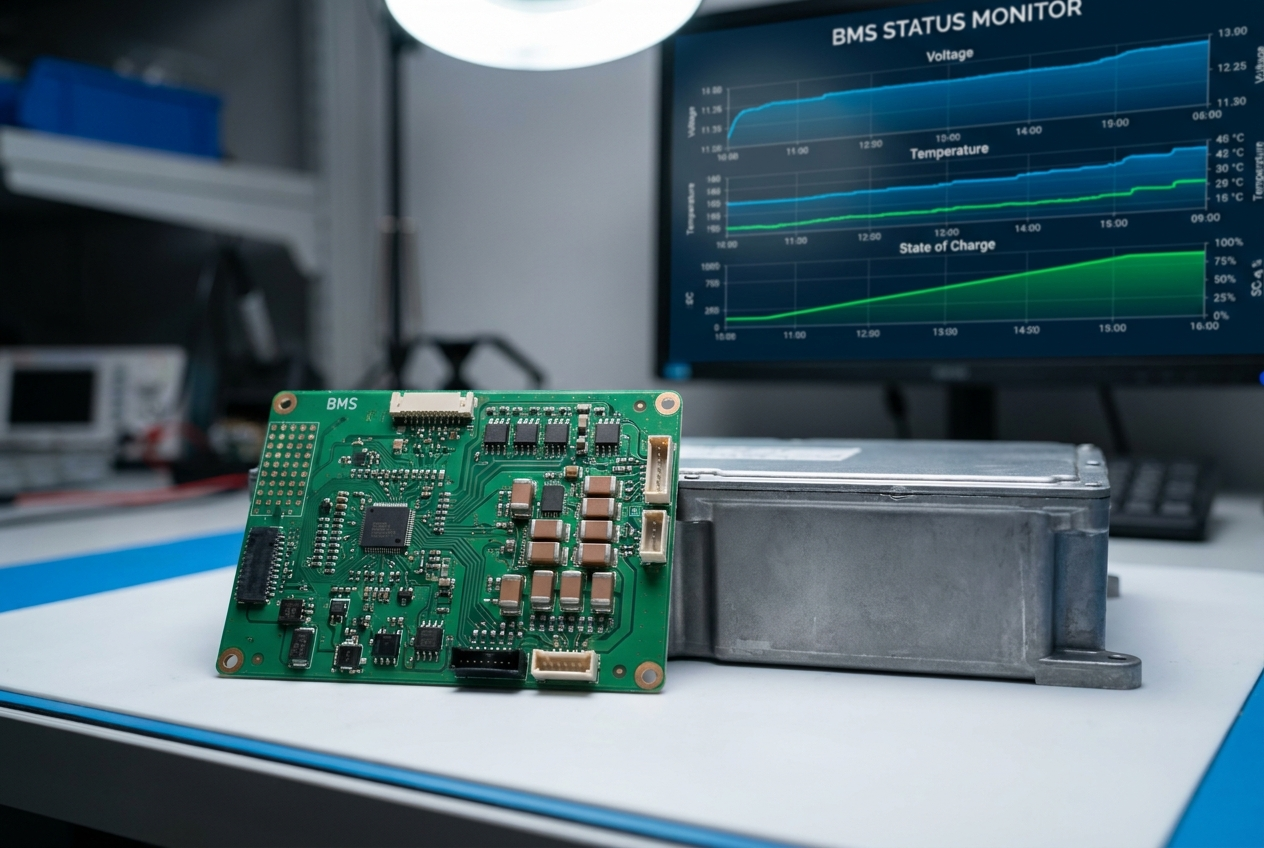
The BMS continuously monitors individual cells, measuring voltage, temperature, and charge state. Advanced algorithms balance charge distribution, prevent overcharging, and protect against dangerous overdischarge conditions.
In practical terms, the BMS is responsible for:
- Cell balancing: Ensuring all cells charge and discharge evenly, preventing any single cell from being overworked or undercharged, which would reduce the pack's overall usable capacity
- State of charge (SOC) estimation: Calculating how much energy remains and translating this into your estimated range display
- State of health (SOH) monitoring: Tracking degradation over time and adjusting usable capacity accordingly
- Thermal protection: Limiting charge or discharge rates when temperature falls outside safe bounds
- Safety management: Disconnecting the pack from the vehicle in the event of a serious fault, collision, or thermal event
Without a well-designed BMS, even a chemically perfect battery pack would degrade rapidly or behave dangerously. It's one of the most important and least-discussed components in any EV.
Component 3: The inverter
The inverter is the brain behind the motor. It converts the DC (direct current) stored in the battery into AC (alternating current) required by most electric motors. But more than just a power converter, the inverter also controls motor speed and torque by adjusting the frequency and amplitude of the current.
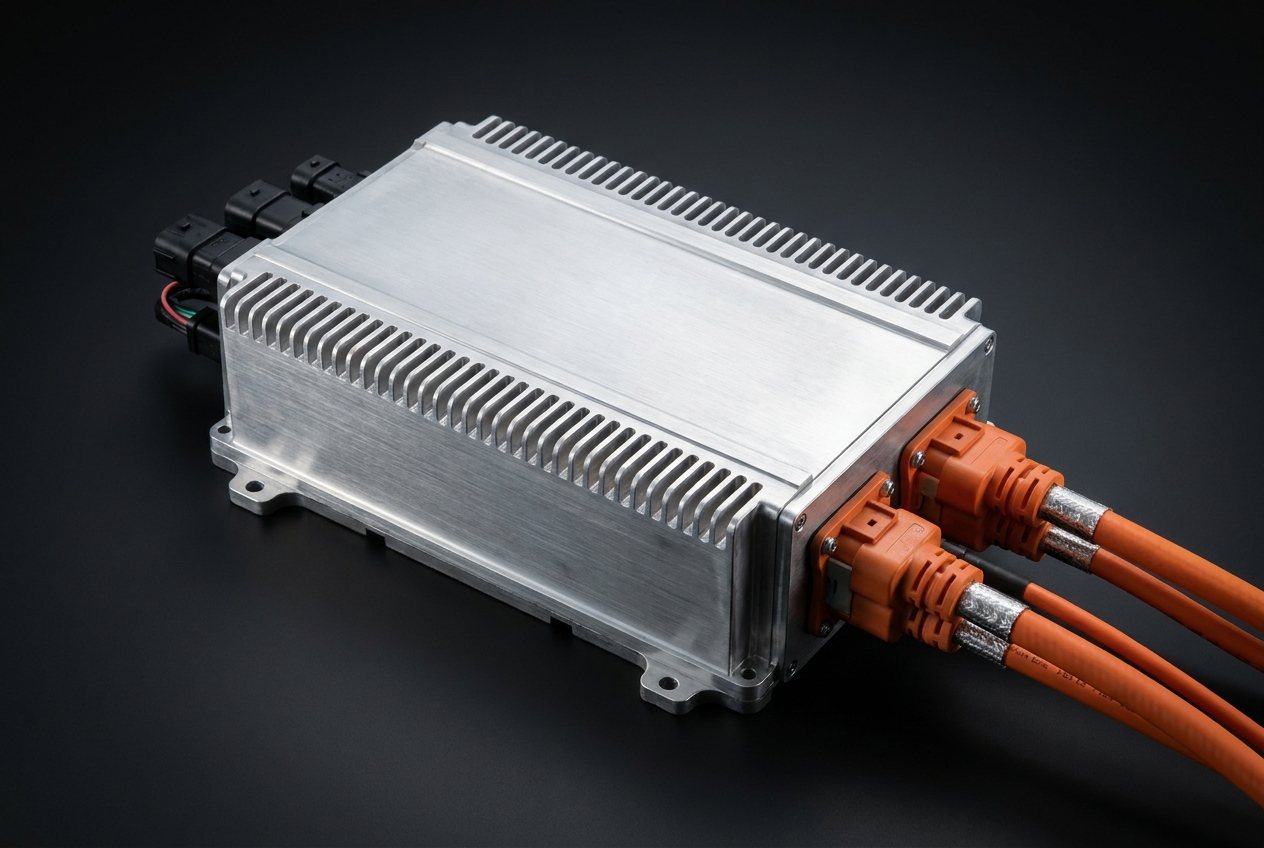
This control function is what makes the inverter so critical. When you press the accelerator pedal, you're not directly controlling the motor, you're sending a signal to the inverter, which then precisely adjusts the frequency and amplitude of the AC current it feeds to the motor to produce exactly the torque you've requested, thousands of times per second.
Modern inverters use semiconductor technology such as IGBT or silicon carbide (SiC) switches to optimise efficiency, switching speed, and heat resistance. In many EVs, the inverter is integrated with the motor housing to reduce weight and wiring complexity.
Silicon carbide inverters in particular represent a significant advance, they switch faster, run cooler, and waste less energy as heat than older IGBT designs, directly contributing to improved range and charging efficiency. Most premium EVs launched from 2023 onwards use SiC inverters.
During regenerative braking, the inverter reverses this process, converting AC from the motor back into DC to recharge the battery. The inverter is the component that makes regenerative braking possible, it runs the energy conversion in both directions.
Component 4: The electric motor
Torque is generated directly by electromagnetic forces, which act immediately when current flows through the motor windings. Typical operating speeds range from 10,000 to 20,000 RPM, significantly higher than conventional engines.
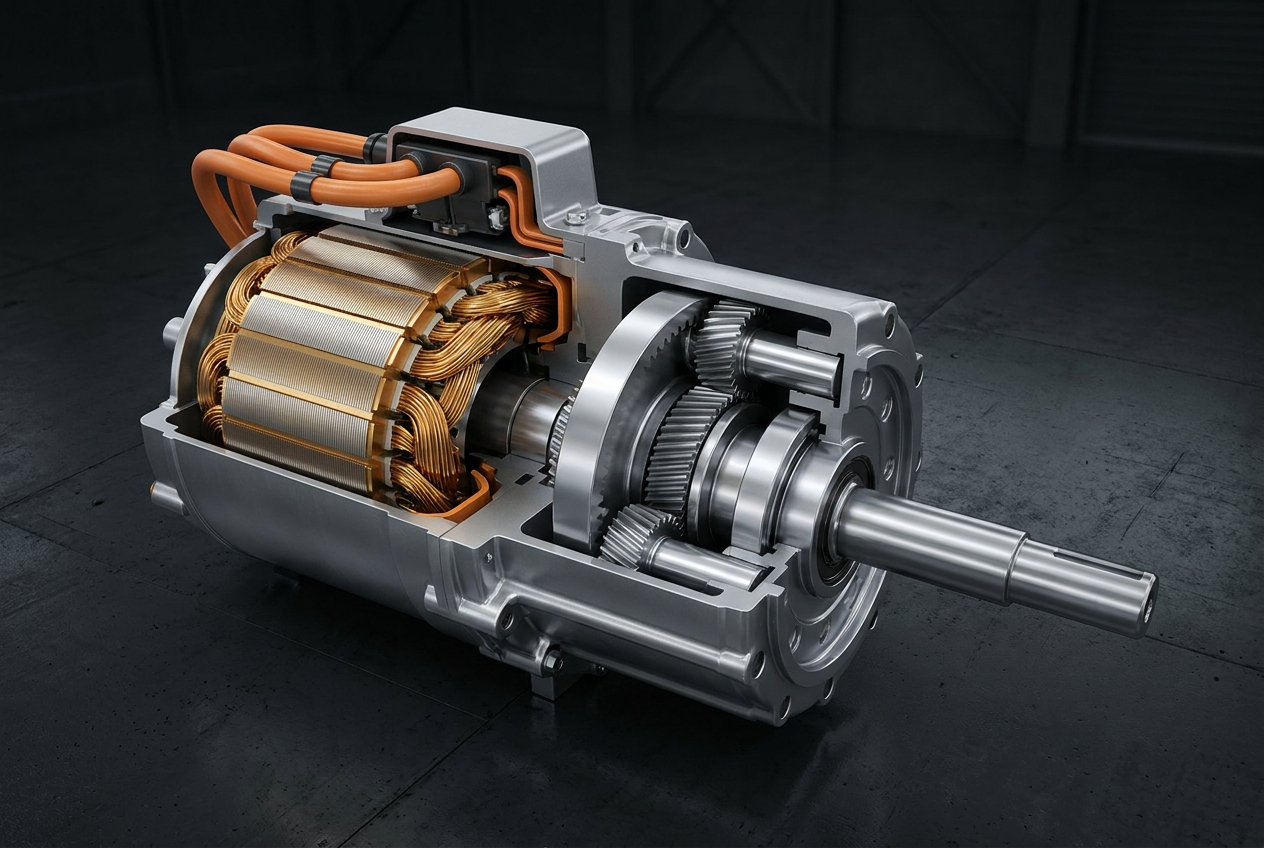
The electric motor in an EV converts the AC electrical current from the inverter into rotational mechanical force. Most modern EVs use a permanent magnet synchronous motor (PMSM), permanent magnets embedded in the rotor are pulled around by a rotating magnetic field generated in the stator windings, producing smooth, continuous torque from zero RPM.
The key performance characteristics of an EV motor that matter for everyday driving:
Peak power (kW): The maximum output the motor can sustain for short periods. Determines acceleration capability, a 150kW motor (like the VW ID.4 Pro's rear motor) produces approximately 200 horsepower equivalent.
Continuous power: Lower than peak power, this is what the motor can sustain indefinitely. Relevant for sustained high-speed driving, hill climbing, and towing.
Peak torque (Nm): The rotational force produced. Available from zero RPM, this is why EVs feel so immediate from a standstill. The VW ID.4 Pro produces 310Nm of torque, available the instant you touch the accelerator.
Efficiency: The best permanent magnet motors achieve 95–97% efficiency in converting electrical energy to mechanical output, compared to 20–40% for a petrol engine. Most of the energy put in actually reaches the wheels.
Component 5: The reduction gearbox
Unlike traditional vehicles with multi-speed transmissions, most EVs use a single-speed reduction gear. This is because electric motors can operate efficiently across a wide RPM range without the need for shifting gears.
The reduction gearbox serves a simple but important function: the electric motor spins very fast (10,000–20,000 RPM) but the wheels need to turn much more slowly (typically under 1,000 RPM at motorway speed). The reduction gear converts the motor's high-speed, lower-torque rotation into the lower-speed, higher-torque output the driven wheels need.
A typical reduction ratio might be around 9:1, meaning for every nine rotations of the motor output shaft, the wheel turns once. This mechanical multiplication also amplifies the motor's torque, which is why a relatively compact EV motor can move a 2,000kg vehicle so effortlessly.
In dual-motor AWD EVs, each motor has its own reduction gear and drives its respective axle independently, allowing torque to be split between front and rear in real time for optimal traction and handling.
Component 6: The onboard charger (OBC)
The onboard charger handles AC charging, converting the alternating current from your home wallbox or a public AC charger into the direct current the battery can store.
Typical onboard chargers range from 3.3kW to 11kW, though some high-end models support up to 19.2kW for faster home charging. The capacity of the OBC determines your maximum AC charging speed, which is why plugging a 7.2kW OBC vehicle into an 11kW wallbox still only charges at 7.2kW. The bottleneck is inside the car, not in the charger.
For DC fast charging, the onboard charger is bypassed entirely, converted DC power is fed directly into the battery pack by the charging station's own conversion hardware.
Component 7: The DC-DC converter
Separate from the onboard charger, the DC-DC converter steps the high-voltage battery pack's output (typically 300–800V) down to 12V to power the vehicle's conventional 12V systems, lights, infotainment, power windows, and the 12V auxiliary battery that manages startup and low-voltage electronics.
This is why every EV still has a 12V auxiliary battery, separate from the main traction battery. If the 12V auxiliary battery fails, the car's electronics can't wake up the main high-voltage system, making it one of the most commonly overlooked maintenance items on EVs.
Component 8: The thermal management system
Batteries and motors get hot. If they get too hot, they fail. The thermal management system pumps coolant through the battery and motor, keeping everything at the right temperature.
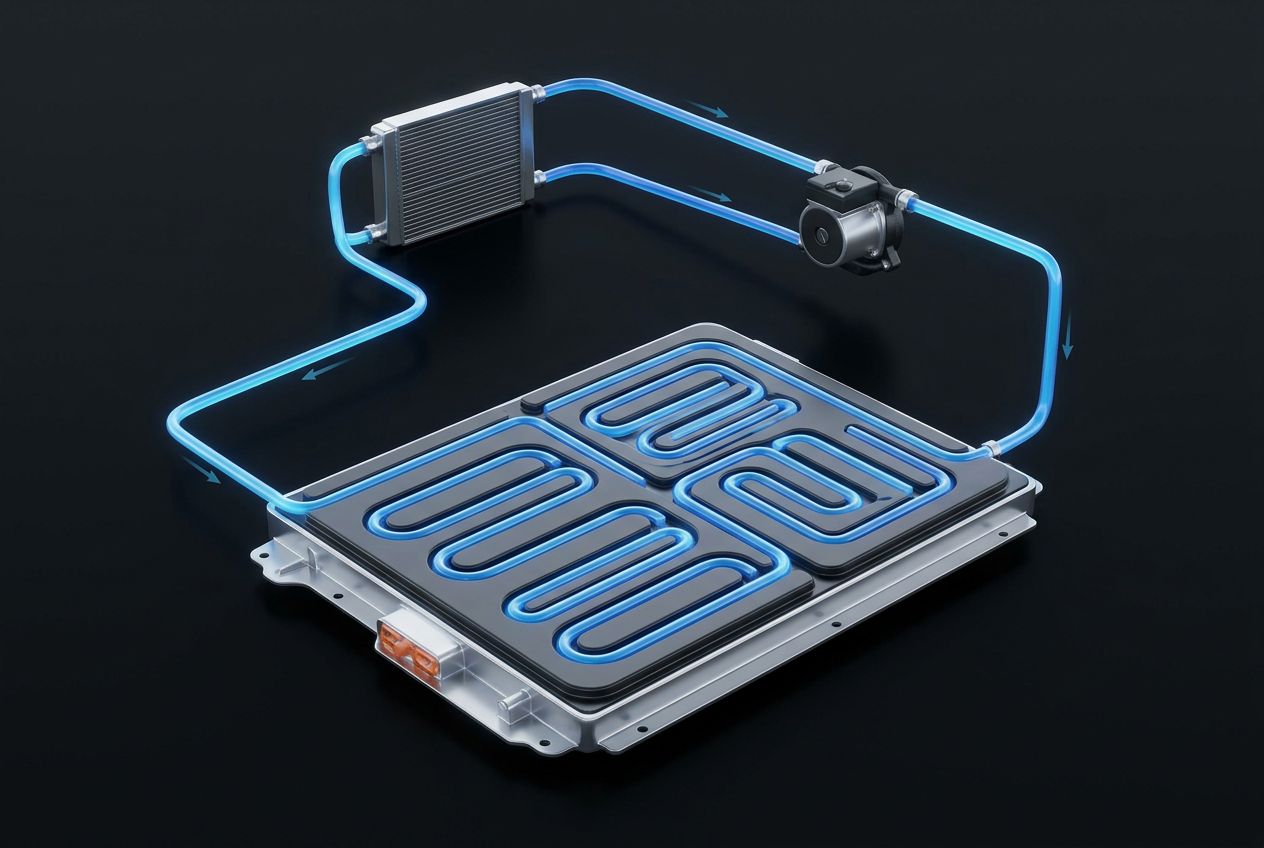
Thermal management is genuinely one of the most important engineering challenges in EV design, and one of the biggest differentiators between EV models. A well-designed thermal system:
- Maintains the battery within its optimal operating temperature range (typically 15–35°C)
- Pre-conditions the battery before DC fast charging to improve charge acceptance and speed
- Manages heat generated during hard acceleration or sustained high-speed driving
- Protects against cold-temperature performance loss
The Nissan Leaf's well-documented battery degradation issues, particularly on earlier models, are largely attributable to its air-cooled thermal management system, which was less effective at managing heat than the liquid-cooled systems used by Tesla, Hyundai, and most current-generation EVs. Thermal management quality directly affects battery longevity, fast charging speed, and cold-weather range.
How it all works together, the energy flow
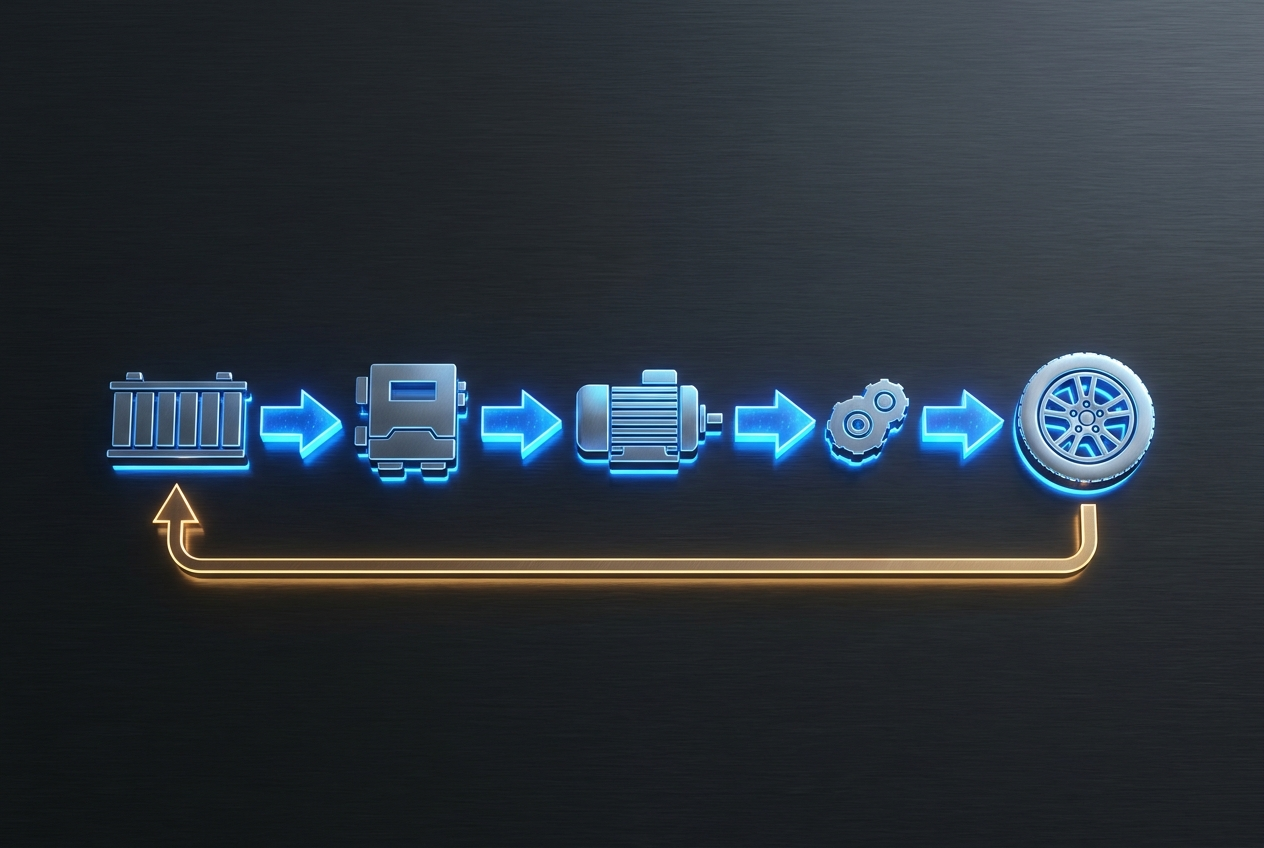
Driving: Battery → BMS (monitors and manages) → Inverter (DC to AC, torque control) → Electric motor (electrical to mechanical) → Reduction gearbox (speed reduction, torque multiplication) → Driveshafts → Wheels
Regenerative braking: Wheels → Driveshafts → Reduction gearbox → Electric motor (now acting as generator, mechanical to electrical) → Inverter (AC to DC conversion) → BMS → Battery (energy returned)
AC home charging: Wallbox (AC) → Onboard charger (AC to DC conversion) → BMS → Battery
DC fast charging: Charging station (DC, already converted) → BMS → Battery (OBC bypassed entirely)
How EV powertrain complexity compares to petrol
A conventional petrol engine has hundreds of moving parts, valves, pistons, timing chains, camshafts, crankshafts, fuel injectors, spark plugs, oil pump, water pump, alternator, starter motor, and more. Every one of these parts wears and eventually needs attention.
A typical EV powertrain has approximately three moving parts in the motor and gearbox. The battery has no moving parts at all. The inverter, BMS, and DC-DC converter are solid-state electronics. The result is dramatically lower maintenance requirements, fewer failure modes, and the kind of reliability record that EV fleets have consistently demonstrated over the past decade.
Disclaimer
The content in this post is based on our own research, experience, and publicly available information and is intended for general informational purposes only. It does not constitute professional technical advice. Specific component specifications, voltages, and performance figures vary between vehicle makes, models, and model years. We encourage readers to consult manufacturer documentation for model-specific technical details.
Target keywords: EV powertrain explained, electric vehicle components explained, how does an EV work, EV drivetrain components