Everything NZ EV owners need to know about servicing their electric vehicle, what's included in a service, how often it needs doing, WOF requirements, and realistic cost expectations.
One of the most compelling reasons to own an electric vehicle is how little it costs to maintain. But "lower maintenance" doesn't mean "no maintenance." Understanding what's actually involved in keeping your EV in top condition and finding a qualified technician to do it is important for every New Zealand EV owner.
This guide covers exactly what an EV service includes, how frequently you need one, what a WOF involves for electric vehicles, and what you should expect to pay in 2026.
|
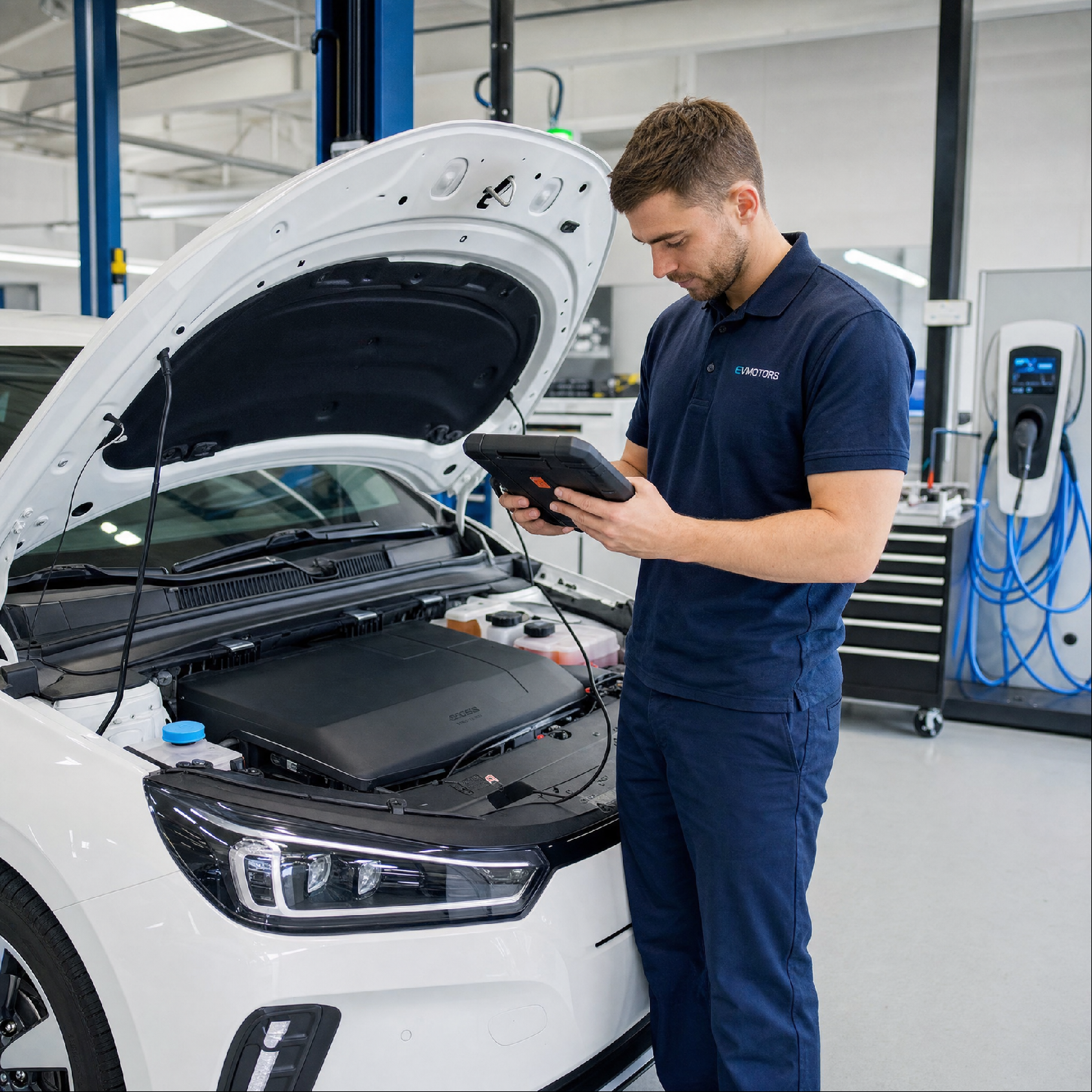 |
How EV servicing differs from petrol car servicing
The fundamental difference is the absence of an internal combustion engine. This eliminates a significant portion of the maintenance tasks that make petrol car servicing costly and frequent:
What EVs don't need:
- Engine oil changes
- Oil filter replacement
- Air filter replacement (engine)
- Spark plug replacement
- Timing belt or chain service
- Exhaust system maintenance
- Fuel filter replacement
- Transmission fluid changes (most EVs have a single-speed reduction drive)
- Coolant flushes (most EVs have simpler thermal management systems)
This is why EV servicing costs roughly a third of what you'd pay for a comparable petrol vehicle. Less to check, less to replace, fewer things to go wrong.
What EVs do need: The components that still require regular attention are primarily the same ones shared with any vehicle: tyres, brakes, suspension, and safety systems plus a handful of EV-specific checks.
What's included in a standard EV service in New Zealand
A comprehensive EV service from a qualified NZ technician should include the following:
Safety and structural checks
- Visual inspection of the high-voltage battery housing for damage or leaks
- Check of HV cable condition and insulation
- Inspection of 12V auxiliary battery (used for lights, accessories, and systems startup)
- Check of high-voltage system for fault codes via diagnostic software
Mechanical checks (shared with petrol vehicles)
- Tyre inspection and rotation (condition, tread depth, pressures)
- Brake inspection, pad thickness, rotor condition, brake fluid level
- Suspension and steering inspection
- Wheel bearing check
- Lights and horn function
EV-specific maintenance items
- Brake fluid replacement: Every 2 years or as per manufacturer schedule. Brake fluid absorbs moisture over time, which lowers its boiling point. This matters even though EVs use brakes less, the fluid still degrades.
- Cabin air filter: Replace every 12–24 months depending on conditions. Especially important in cities or areas with high pollen or dust.
- Battery coolant check: On models with liquid thermal management (most modern EVs). The coolant should be topped up and inspected for contamination.
- Traction motor and inverter check: For any unusual noise or performance issues.
- Software and firmware updates: Many EV manufacturers release updates that improve battery management, range, or charging behaviour. A qualified technician can apply these during a service.
Pre-WOF preparation (if due)
- Lights, wipers, horn
- Tyre condition and pressures
- Steering and suspension
- Brake performance
How often does an EV need to be serviced in New Zealand?
Most EV manufacturers recommend an annual service, or every 15,000–20,000km, whichever comes first.
For New Zealand drivers covering the national average of approximately 11,500km per year, an annual service aligns well with both calendar and mileage-based requirements.
Recommended service schedule:
| Interval |
Service type |
| Every 12 months / 15,000km |
Full inspection, tyre rotation, cabin filter check, HV system check, software updates |
| Every 2 years |
Brake fluid replacement, coolant check, 12V battery assessment |
| Every 40,000–60,000km |
Coolant replacement (model-dependent) |
| As required |
Tyre replacement, brake pad replacement, 12V battery replacement |
Always refer to your vehicle's owner's manual for model-specific intervals. Manufacturer guidelines take precedence.
Do electric cars need a WOF in New Zealand?
Yes. Electric vehicles are subject to exactly the same Warrant of Fitness requirements as petrol vehicles in New Zealand. A WOF is required every 12 months for vehicles over 3 years old.
The WOF inspection covers:
- Lights (headlights, indicators, brake lights, reverse lights)
- Windscreen wipers and washers
- Tyres (tread depth minimum 1.5mm, no damage)
- Steering (play, condition)
- Suspension (wear, damage)
- Brakes (performance, condition)
- Structural integrity (rust, crash damage)
- Seatbelts
- Glazing (windscreen and windows)
There is no EV-specific component of the WOF test, inspectors are not required to assess the high-voltage system as part of the standard test. However, a qualified EV service will typically include an HV system check as a matter of course, making it good practice to service your EV before its WOF falls due.
WOF cost: $60–$90 at most testing stations in NZ.
What does EV servicing cost in New Zealand?
Based on typical pricing from EV-qualified workshops and service centres across New Zealand in 2026:
| Service type |
Estimated cost |
| Annual inspection and service |
$300–$500 |
| Brake fluid replacement |
$80–$150 |
| Cabin air filter |
$50–$100 (parts + labour) |
| Tyre rotation |
$60–$80 |
| 12V battery replacement |
$180–$300 |
| WOF |
$60–$90 |
| Full annual service + WOF |
$350–$550 combined |
Prices vary by region and provider. Auckland and Wellington typically sit at the higher end; smaller centres may charge less.
Compare this to a petrol car: A comprehensive annual service plus WOF for a petrol vehicle typically costs $1,000–$1,500 in New Zealand. Over five years of EV ownership, you're likely to save $3,500–$5,000 in servicing costs alone.
Finding a qualified EV technician in New Zealand
Not all mechanics are trained to work on electric vehicles. High-voltage systems require specific safety training and equipment attempting HV system work without the right qualifications is genuinely dangerous.
When choosing a service provider for your EV, look for:
- Technicians with MITO or equivalent high-voltage vehicle training
- Workshops with EV-specific diagnostic equipment
- Dealers or service centres for your specific brand (Tesla, Hyundai, MG, etc.)
- Independent EV specialists who can service multiple brands
Ask specifically whether the technician is qualified to inspect and work on the high-voltage system, not just the standard mechanical components.
Common EV maintenance questions
Do EV brakes need replacing as often as petrol car brakes?
No, usually much less often. Regenerative braking handles most of the slowing in an EV, which significantly reduces wear on brake pads. Many EV owners report 80,000–100,000km from a single set of pads. However, rotors can corrode faster from underuse, so they should be inspected regularly even if pad wear is minimal.
Do EVs need engine coolant?
Most modern EVs use liquid cooling for the battery pack and electric motor, but it's a separate system from the engine coolant circuit in a petrol car. This coolant should be checked periodically and replaced according to the manufacturer's schedule.
What happens if the 12V battery fails in an EV?
The 12V auxiliary battery powers your EV's electronics, lights, and the systems that wake up the main high-voltage battery. If it fails, the car may not start or respond. The 12V battery should be tested at every service, replacement is straightforward and relatively inexpensive ($180–$300).
Can any mechanic service an EV?
For general items like tyres, brakes, and suspension, any qualified mechanic can help. For anything involving the high-voltage system — battery, motor, inverter, charging system, you need a technician with HV vehicle qualifications.
Keeping your EV properly serviced is straightforward and affordable. An annual service and WOF with a qualified EV technician will keep your vehicle running reliably, protect your battery investment, and ensure you stay safe on New Zealand roads.
Want to book a service or have questions about what your EV needs? Get in touch with our team, we specialise in pre-owned EV sales and full EV servicing
The content in this post is based on our own research, experience, and opinion and is intended for general informational purposes only. It does not constitute professional financial, technical, or legal advice. While we strive for accuracy, figures, regulations, and specifications referenced — including pricing, RUC rates, battery data, and technology timelines — are subject to change and may vary by circumstance. We encourage readers to conduct their own research and consult qualified professionals before making any significant purchasing or financial decisions. External links and references are provided for convenience and do not constitute endorsement.
Last updated: June 2026