Buying a used electric vehicle in New Zealand has never made more sense. With petrol prices hovering around $3.30 a litre in 2026 and the country's EV fleet growing to nearly 100,000 vehicles, the pre-owned market is more mature and more affordable than ever before.
But buying a second-hand EV is a different process to buying a used petrol car. There are new things to check, new questions to ask, and a few traps that catch out first-time buyers.
This guide covers everything you need to know before signing anything.
|
 |
Why buy a used EV in New Zealand?
The financial case is compelling. EVs cost roughly $3–4 per 100km to charge at home overnight, compared to $15–20 per 100km for a petrol car at current fuel prices. Add to that lower servicing costs (typically $300–$500 per year versus $1,000–$1,500 for a petrol vehicle) and you have a vehicle that costs significantly less to run from day one.
The used market has also matured considerably. Models that were new just a few years ago Nissan Leafs, Hyundai Ioniq 5s, MG ZS EVs, and Tesla Model 3s are now available at accessible price points, often well under $30,000.
Step 1: Set your budget and range requirements
Before browsing listings, be clear about two things: how much you want to spend, and how far you need to drive on a typical day.
Most New Zealanders drive fewer than 50km daily, which means almost any modern used EV will comfortably cover your needs. However, if you regularly do longer runs Auckland to Hamilton, Wellington to Palmerston North you'll want a vehicle with at least 200–250km of real-world range.
Budget ranges in the NZ used EV market (2026):
- Under $15,000: Older Nissan Leaf models (24–40kWh), mostly Japanese imports. Lower range but very cheap to run.
- $15,000–$25,000: Newer Nissan Leafs, used MG ZS EVs, some used Hyundai Ioniq models.
- $25,000–$40,000: Used Tesla Model 3, used Hyundai Kona Electric, used Kia EV6 base variants.
- $40,000+: Near-new EVs, used Tesla Model Y, used Polestar 2, VW ID.4, Volvo C40
Step 2: Understand battery state of health (SOH)
This is the single most important thing to check when buying a used EV. Battery state of health (SOH) is a percentage that tells you how much of the original battery capacity remains.
A brand-new EV has 100% SOH. Over time, through charging cycles and general use, that number decreases. Most manufacturers guarantee battery capacity above 70–75% for 8–10 years or a set number of kilometres.
What's a good SOH for a used EV?
- 90%+ — Excellent. The battery has lost very little capacity.
- 75–89% — Great. A degree of range reduction but still very usable.
- 60–74% — Acceptable for the right price. Factor in the reduced range.
- Below 60% — Price relative, understand what range can be expected and ensure this works for you
A reputable dealer should be able to show you a verified Battery State of Health -SOH on request. If they are unable to, most EV specialists workshops should be able to perfrom a SOH test with manufacturer diagnostic tools or a trusted third party battery tester like Aviloo
Step 3: Know what else to check
Beyond the battery, a used EV inspection covers several areas:
Charging system
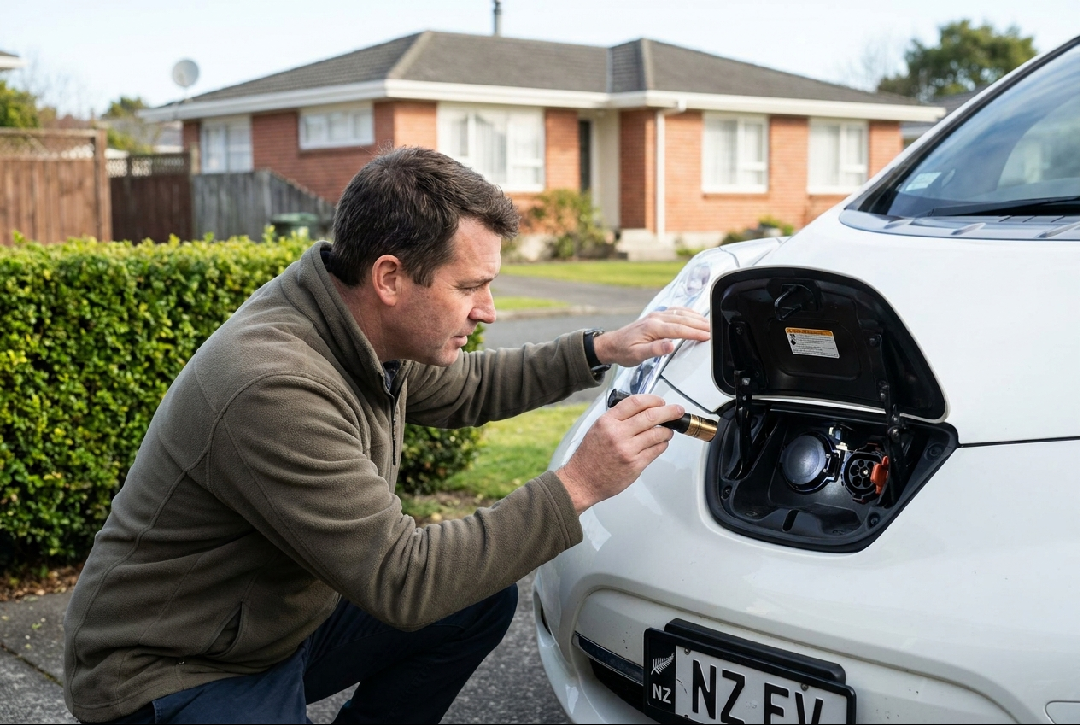
- Test both slow (Type 1 / 2) and fast charging (CHAdeMO or CCS) if the vehicle supports both.
- Check that the charging port door opens and closes smoothly and the port shows no signs of damage or corrosion.
- Ask for a log of recent charging sessions if available.
|
 |
Software and updates
- EVs are software-driven vehicles. Check that the vehicle's firmware is up to date.
- Ask whether the manufacturer still provides over-the-air updates for the model, or if offline updates are available
Tyres
- EV tyres wear faster than on petrol cars due to the instant torque and heavier weight. Check tread depth and look for uneven wear patterns.
Brakes
- Counterintuitively, EV brake pads often last longer than on petrol cars because regenerative braking handles most of the slowing. However, rotors can corrode from underuse. Have them inspected.
Interior and electronics
- Test every screen, climate control setting, and connectivity feature. These systems can be expensive to repair outside warranty.
Service history
- Ask for a complete service record. A well-maintained used EV should have regular WOF and service records.
Step 4: Get a pre-purchase inspection
Always get an independent pre-purchase inspection (PPI) from a qualified EV technician before buying. This typically costs $150–$300 but can save you thousands.
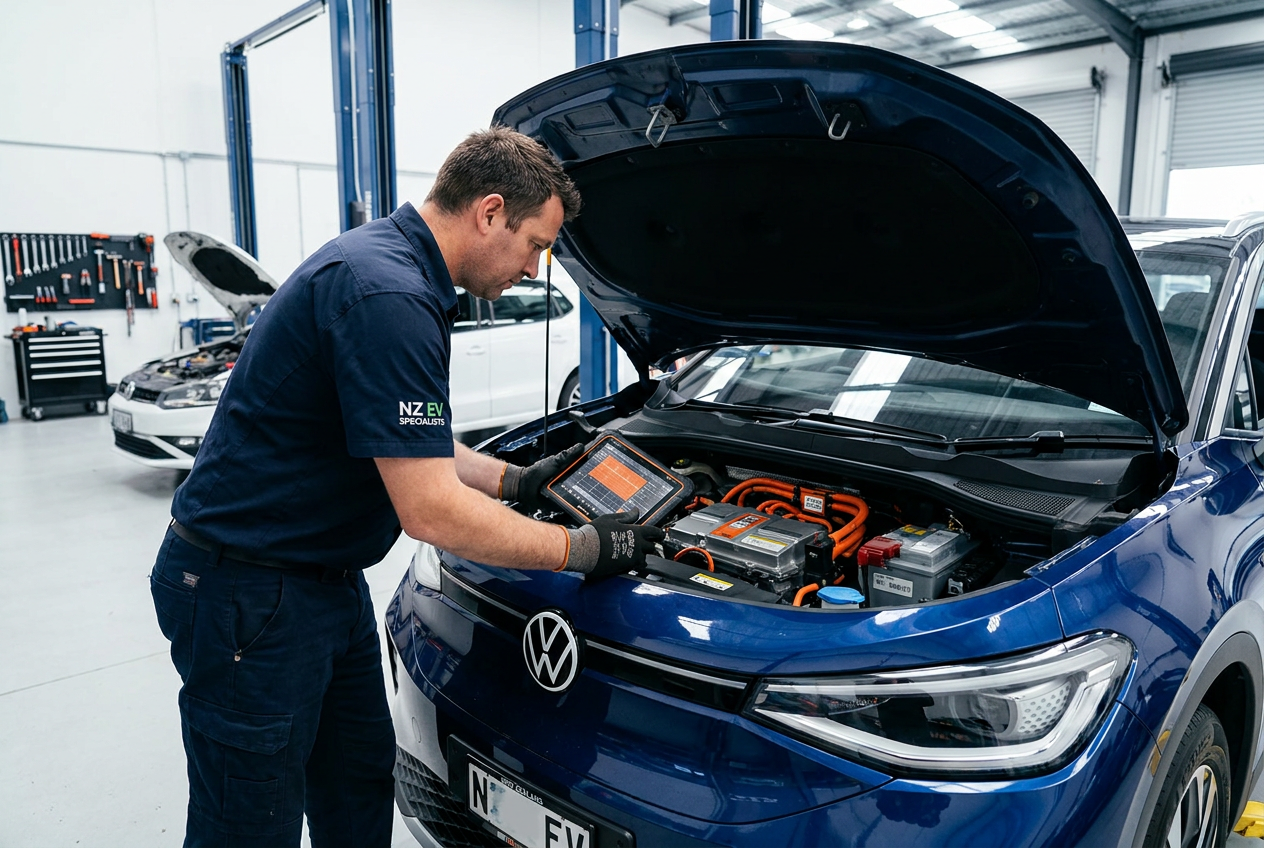 |
A good EV-specialist inspection will:
- Read fault codes from all control modules
- Check battery SOH using diagnostic software
- Inspect high-voltage system components
- Test charging on both AC and DC
- Check for any flood or accident damage
|
Not all general mechanics are qualified to inspect EVs make sure you use someone with EV-specific training and equipment.
Step 5: Where to buy a used EV in New Zealand
EV-specialist dealers offer certified pre-owned stock with battery guarantees and EV-specific warranty cover. These command a small premium but provide significantly more peace of mind.
Private sales can offer savings but come with no warranty protection. If buying privately, the pre-purchase inspection becomes even more critical.
Step 6: Understand ongoing ownership costs in NZ
Once you own an EV, the main ongoing costs are:
Road User Charges (RUC): As of 2026, all EVs pay $76 per 1,000km. You purchase these in advance from NZTA and display the licence in your vehicle. Budget around $875 per year based on the average NZ driving distance of approximately 11,500km.
Registration and ACC levy: Similar to petrol vehicles, though ACC levies for EVs have increased in recent years.
Home charging: Most EV owners install a Level 2 wallbox charger. Overnight charging on off-peak rates works out to approximately $3–4 per 100km.
Servicing: Typically $300–$500 per year — roughly a third of what you'd spend on a petrol car.
Insurance: EV insurance tends to run slightly higher than for equivalent petrol vehicles, largely due to battery replacement costs. Compare quotes before purchasing.
Common mistakes first-time buyers make
Buying on range alone. Real-world range is often 20–30% less than the manufacturer's WLTP figure, particularly in cold weather or at motorway speeds. Always ask for real-world estimates from the seller.
Ignoring the charging speed. Some older EVs only support slow AC charging. If you ever need to fast-charge on a road trip, check that the vehicle supports DC fast charging.
Not checking Japanese import specifics. The Nissan Leaf dominates the used import market and most come from Japan. These are generally reliable, but check the battery SOH carefully Japanese driving conditions can result in more battery degradation in some models.
Skipping the PPI. A few hundred dollars upfront is nothing compared to a battery replacement bill.
Ready to find your next EV?
Whether you're after an affordable runabout or a long-range family vehicle, the New Zealand used EV market in 2026 offers more choice at better prices than ever before. Take your time, do your checks, and you'll be driving past every petrol station with a smile.
If you'd like help with the inspection process or want to know more about EV servicing and ownership costs, explore our other guides or get in touch with our team. View our selection of quiality hand picked electric vehicles for sale here
|
 |
The content in this post is based on our own research, experience, and opinion and is intended for general informational purposes only. It does not constitute professional financial, technical, or legal advice. While we strive for accuracy, figures, regulations, and specifications referenced — including pricing, RUC rates, battery data, and technology timelines — are subject to change and may vary by circumstance. We encourage readers to conduct their own research and consult qualified professionals before making any significant purchasing or financial decisions. External links and references are provided for convenience and do not constitute endorsement.
Last updated: June 2026