Confused about New Zealand's give way rules? Here's a clear, plain-English guide to who gives way at intersections, T-junctions, roundabouts, and pedestrian crossings.
Give way rules are one of those things every Kiwi driver is supposed to know cold, yet plenty of us get a little fuzzy on the details, especially the trickier turning scenarios. Getting them wrong is not just a warrant of fitness for embarrassment, it is a genuine safety issue and a common cause of crashes at intersections.
So here is a clear, plain-English guide to New Zealand's give way rules, based on the official NZTA Road Code. Whether you are learning to drive, refreshing your knowledge, or settling an argument, this covers the situations you will actually encounter. One quick note before we start: the rules here are current as of 2026, but road rules can be updated, so the NZTA Road Code is always the definitive source if you need to be certain.
First, what does "give way" actually mean?
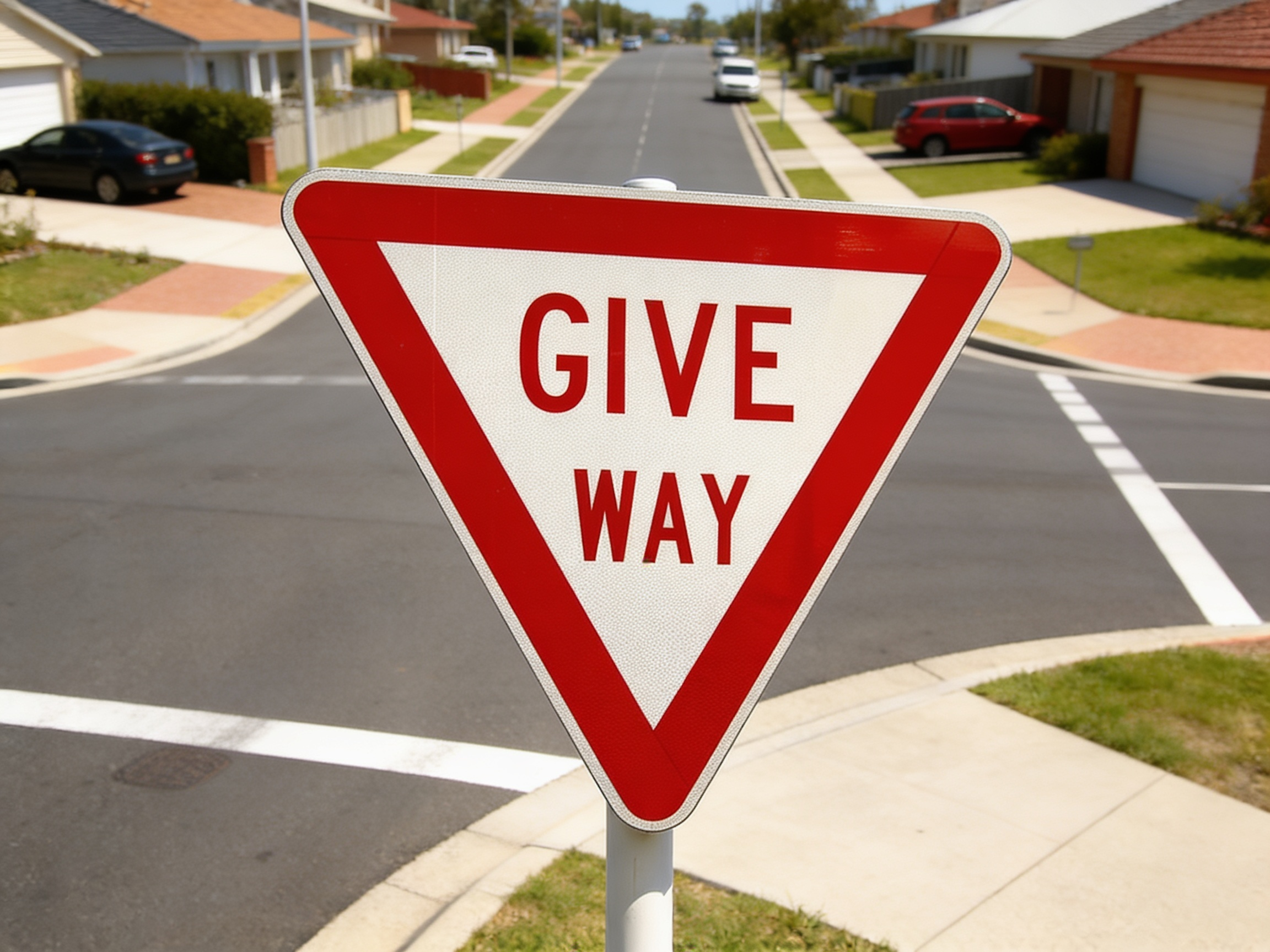
It is worth being precise about this, because it is more specific than most people realise. Giving way means the road user you are giving way to, whether they are a driver, cyclist, or pedestrian, does not need to stop, brake, slow down, swerve, or take any evasive action because of you.
In other words, it is not enough to simply avoid a crash. If the other party has to brake or slow down to accommodate you, you have not given way properly. You must wait until you can proceed without affecting them at all.
The two golden rules that cover most situations
Almost every give way situation in New Zealand comes back to two core principles. If you remember nothing else, remember these.
Golden rule 1: Give way to your right. In most situations where two vehicles would otherwise cross paths and there are no signs or signals dictating otherwise, you give way to the vehicle on your right. This applies at uncontrolled crossroads and at roundabouts.
Golden rule 2: If you are turning, give way to traffic that is not turning. If you are turning and another vehicle is going straight through, you give way to them. Straight-through traffic has priority over turning traffic.
A huge number of everyday situations are resolved by just these two rules. Now let's look at the specific scenarios.
Uncontrolled intersections (no signs or signals)
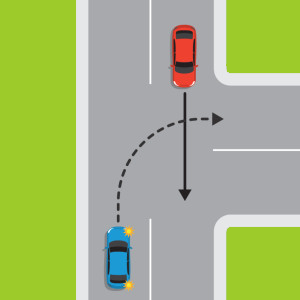
An uncontrolled intersection is one with no stop signs, no give way signs, and no traffic lights. These are common in quiet suburban and rural areas.
At an uncontrolled crossroads: the "give way to your right" rule applies. If a vehicle is approaching from your right and your paths would cross, you give way to it.
If you are turning: remember golden rule 2. If you are turning and an oncoming vehicle is going straight through, you give way to them.
The key right-turn rule: if you are turning right, you must give way to all vehicles coming towards you, including those turning left. This is the one people most often get wrong. When you want to turn right across the path of oncoming traffic, you wait for that traffic, even if an oncoming car is only turning left.
T-intersections
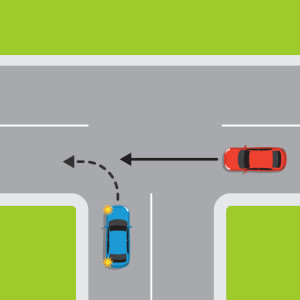
A T-intersection is where one road ends at another road that continues. This is where a very important rule applies, and it actually overrides the "give way to the right" rule.
The terminating road gives way to the continuing road. If you are on the road that ends (the bottom of the T) and you want to turn onto the road that continues (the top of the T), you must give way to all traffic on the continuing road, in both directions.
This trips people up because it can override the give-way-to-the-right instinct. Even if a vehicle on the continuing road is coming from your left, you still give way to it, because you are on the terminating road and they are on the continuing road. The "give way to the right" rule only applies at crossroads, not at T-intersections.
Think of it this way: the road that keeps going has priority over the road that stops. It is a simple, intuitive idea once it clicks, and it makes sense, the through road is the main flow of traffic.
Give way signs and stop signs
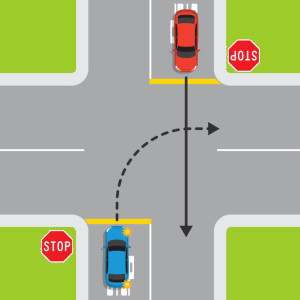
When signs are present, they take priority over the general give way rules.
Give way sign: slow down, and be prepared to stop if necessary. You must give way to all traffic that is not facing a sign, or that is facing a lesser instruction. You only need to actually stop if there is traffic you must give way to.
Stop sign: you must come to a complete stop, every time, even if the road is clear. The word STOP and a solid yellow line are painted on the road. After stopping, give way to all other traffic before proceeding. A stop sign gives you the lowest priority at the intersection.
When two vehicles both face give way or stop signs: if you are both facing the same type of sign, you revert to the standard give way rules between yourselves, so give way to the right, and turning traffic gives way to straight-through traffic.
The right-turn rule at traffic lights
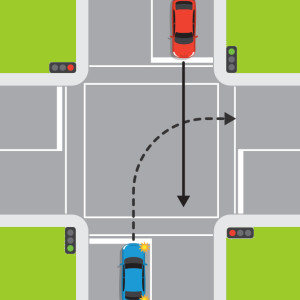
At traffic lights, a green light means you can go if it is safe, but the turning rules still apply.
If you are turning right on a green light, you must give way to oncoming traffic that is going straight through or turning left, and you must give way to pedestrians crossing the road you are turning into. You wait for a safe gap, or for the traffic to clear, before completing your turn.
A yellow light means stop, unless you are so close that you cannot stop safely. It means the light is about to turn red. It does not mean speed up to beat the light.
A red light means stop, every time.
When two vehicles are both turning right
Here is a scenario that confuses a lot of people, and the answer is reassuringly simple.
When two vehicles are coming towards each other and both are turning right, neither has to give way to the other. This is because, in most cases, your paths do not actually cross, you each turn across into your respective roads without meeting. So you can both turn at the same time.
Two things to watch, though. First, be careful if the other vehicle is a large truck or bus, as it may need more room to complete its turn and your paths could cross. Second, watch out for traffic behind the vehicle opposite that might be going straight through rather than turning, your view of the road beyond the turning vehicle can be blocked.
Roundabouts
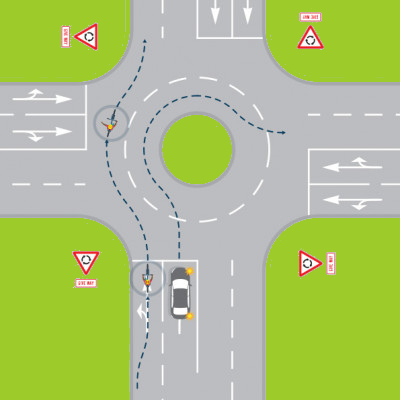
Roundabouts follow the "give way to your right" golden rule, which keeps them flowing smoothly once you understand it.
As you approach a roundabout, slow down and be prepared to give way. You must give way to all vehicles that will cross your path from your right, which includes vehicles already on the roundabout and vehicles entering from a road to your right whose path will cross yours.
Only enter when there is a safe gap and you will not force anyone already on the roundabout, or entering from your right, to slow down or stop.
Signalling on roundabouts matters and is often done poorly. If you are turning left (first exit), signal left on approach. If you are going straight through, do not signal on approach, but signal left as you pass the exit before the one you want. If you are turning right (more than halfway around), signal right on approach and stay in the appropriate lane, then signal left as you pass the exit before yours. In short, always signal left as you leave, so others know you are exiting.
On multi-lane roundabouts, follow the lane markings and arrows, get into the correct lane before you enter, and if you need to change lanes to exit, give way to vehicles in the lane you want to move into.
Pedestrians and pedestrian crossings
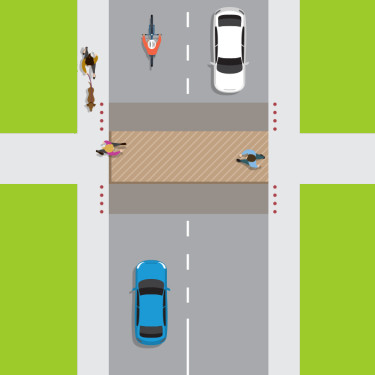
Pedestrians have specific protections, and giving way to them correctly is essential.
At a pedestrian (zebra) crossing, you must give way to pedestrians who are on the crossing or stepping onto it. Slow down on approach and be ready to stop.
When you are turning at an intersection, you must give way to pedestrians who are crossing the road you are turning into. This applies whether you are turning left or right, and it is a rule many drivers overlook.
At traffic lights, give way to pedestrians crossing on a green signal when you are turning.
In a shared zone, marked with the relevant signs, pedestrians have right of way over vehicles at all times, and a low speed limit applies.
The safest mindset is simple: in any situation where you are turning or moving through a space a pedestrian is using, assume you give way to them.
A few other give way situations worth knowing
One-lane bridges. Many rural New Zealand roads have one-lane bridges. A sign will indicate who gives way. A blue rectangular sign with a large white arrow means you have priority, while a red circular sign with a smaller arrow means you must give way to oncoming vehicles. Always slow down and be prepared to stop regardless.
Emergency vehicles. If an emergency vehicle is displaying flashing lights or sounding a siren, you must give way and, where safe, pull over to the left to let it pass.
Police directing traffic. If a police officer is directing traffic, their directions overrule all signs, signals, and give way rules. Follow their instructions.
Entering a road from a driveway or car park. When you pull out of a driveway, petrol station, or car park, you are treated like traffic on a terminating road, so you give way to all traffic on the road you are joining, and to pedestrians on any footpath you cross.
The quick summary
If you remember these, you will handle the vast majority of situations correctly:
- Give way to your right at uncontrolled crossroads and roundabouts.
- If you are turning, give way to traffic going straight through.
- Turning right, give way to oncoming traffic, including those turning left.
- At a T-intersection, the road that ends gives way to the road that continues, even if that traffic is on your left.
- Signs and signals override the general rules, and a stop sign always means a full stop.
- Give way to pedestrians when turning into a road they are crossing, and at crossings.
- A police officer's directions beat everything.
The bottom line
New Zealand's give way rules come down to a small number of clear principles, give way to your right, give way when turning, and respect the road that continues at a T-intersection. Master those, pay attention to signs and signals, and always look out for pedestrians, and you will navigate our intersections safely and confidently.
If you are ever unsure, the NZTA Road Code is the definitive, official source, and it includes helpful diagrams for every scenario. It is well worth a refresher every so often, even for experienced drivers, because a surprising number of us are a little rusty on the details.
Disclaimer
The content in this post is based on the New Zealand Road Code as published by NZTA and is intended for general informational and educational purposes only. It is a simplified summary and does not cover every possible situation. Road rules can be updated over time. For the complete, current, and definitive give way rules, always refer to the official NZTA Road Code at nzta.govt.nz. This post does not constitute legal or professional driving instruction.
Target keywords: give way rules NZ, New Zealand give way rules explained, who gives way at intersection NZ, roundabout give way rules NZ