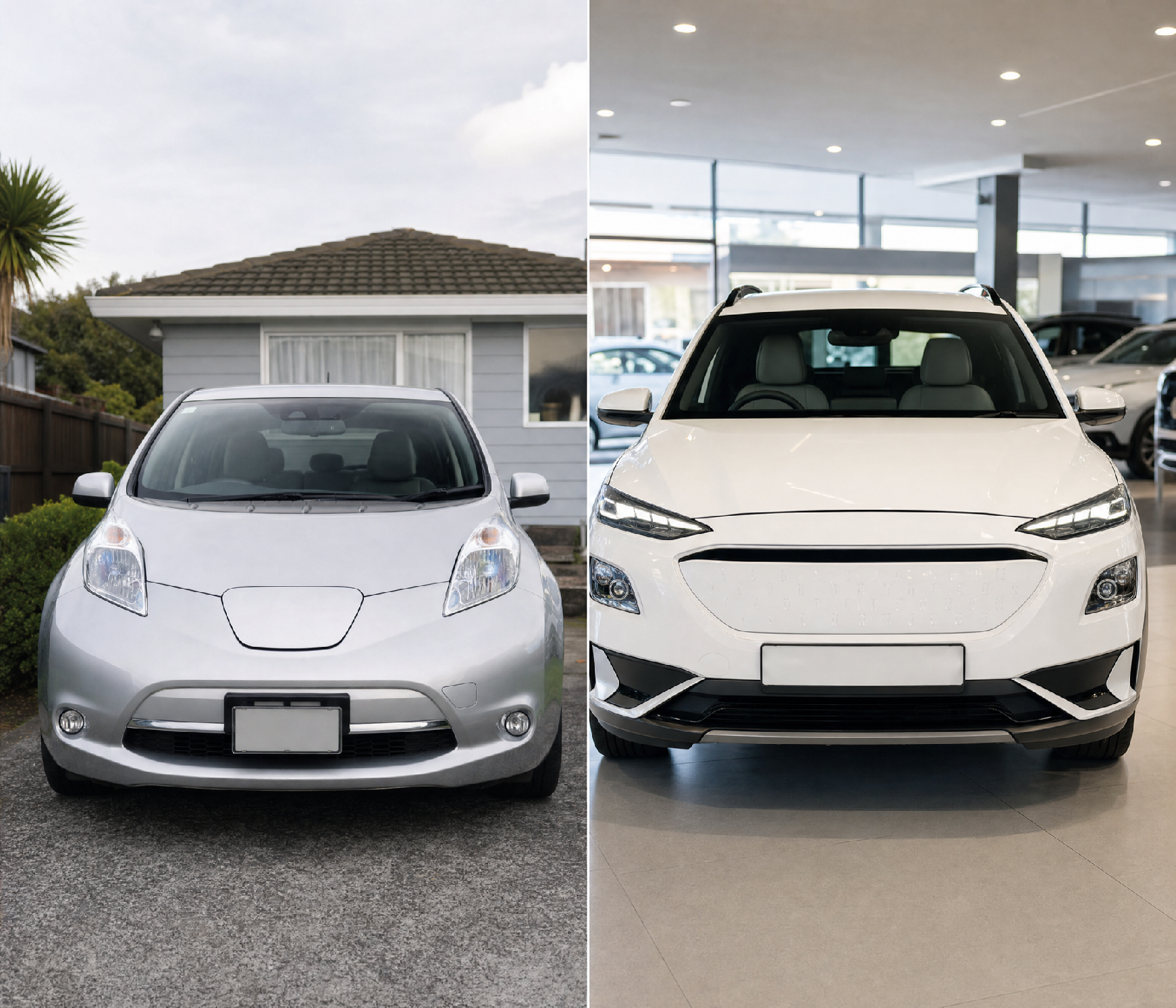
Should you buy a used or new electric vehicle in New Zealand in 2026? We compare purchase price, depreciation, battery warranty, running costs, and total value.
It's one of the most common questions in the NZ EV market right now: is it smarter to buy a used electric vehicle, or stretch the budget for a new one? Both have genuine advantages, and the right answer depends on how you'll use the vehicle, how much you have to spend, and what matters most to you.
Here's an honest, numbers-based comparison.
|
 |
The case for buying used
Lower purchase price - significantly lower
New EVs in New Zealand typically start from $40,000–$60,000 for mainstream models. A comparable used EV from 2–4 years ago can be found for $20,000–$35,000, sometimes less. That's a $15,000–$25,000 difference that either stays in your pocket or can be invested elsewhere.
Someone else took the depreciation hit
New vehicles depreciate fastest in their first two to three years. For EVs, this can be particularly steep, some models lose 25–35% of their purchase price within the first three years. Buy a three-year-old example and someone else has absorbed that loss.
Lower insurance costs
Used EVs generally cost less to insure than new ones, simply because the replacement value is lower. On a model-by-model basis, a three-year-old Tesla Model 3 will command a lower insurance premium than a brand-new one.
Proven reliability in the real world
A used EV that's been running in New Zealand or another market for two to three years is a known quantity, there's owner community data, local service experience, and a track record in real world conditions. New models can occasionally carry early production issues.
Best for: Budget-conscious buyers, those who drive average mileage, buyers who want the lowest total cost of ownership.
The case for buying new
Full manufacturer warranty - including battery
New EVs come with a full manufacturer warranty, typically 3–5 years for the vehicle and 8 years/160,000km for the battery. This is significant protection against the most expensive component failure scenario.
If you're buying used, check how much warranty remains, some newer used EVs will still have 4–5 years of battery cover.
Latest technology and range
EV technology has moved fast. A new 2025–2026 model will typically offer meaningfully better real-world range, faster charging, more advanced driver assistance systems, and better software than a 2021–2022 equivalent.
If range or long-distance capability matters to you, a new vehicle from a current model year may deliver 400–600km real-world versus 250–350km from a used equivalent at the same price point.
Access to manufacturer support and updates
New vehicles from brands with NZ presence, Tesla, BYD, Hyundai, MG, VW come with direct manufacturer support, software update pipelines, and often enhanced roadside assistance. Some used imports from smaller brands may have limited local support.
No unknown history
You know exactly what has happened to the vehicle. No uncertain charging habits, no previous accident history to worry about, no degradation from a previous owner's behaviour.
Best for: Buyers who prioritise peace of mind, those who regularly travel long distances, tech-forward buyers, families.
Head-to-head: same budget, different choices
Budget: $35,000
Option A: New entry-level EV
- New MG4 (base) or BYD Atto 2
- Real-world range: 300–350km
- Full 8-year battery warranty
- Latest technology and software
- Will depreciate 25–30% in 3 years
Option B: 2–3 year old mid-range used EV
- Used Tesla Model 3 Standard Range, or used Hyundai Ioniq 5 entry
- Real-world range: 350–450km
- 3–5 years battery warranty remaining
- Previous owner absorbed biggest depreciation hit
- Proven NZ track record
At $35,000, Option B arguably delivers more vehicle but Option A gives you full warranty from day one and the latest safety systems.
The depreciation factor: why it matters more for EVs
EV depreciation in New Zealand has been more pronounced than for petrol vehicles, driven by several factors:
- Rapid advancement in technology means newer models offer substantially better range and features
- Government incentives and falling new car prices have put downward pressure on used values
- Uncertainty around battery longevity has historically made buyers cautious about used EVs
The flip side: this depreciation curve is your friend when buying used. Models that were genuinely expensive just three years ago are now accessible at mid-market prices.
Rule of thumb: Look for used EVs that are 2–4 years old, have sub-50,000km mileage, and still have battery warranty remaining. This sweet spot captures the best of both worlds, meaningful depreciation absorbed, but useful warranty still active.
What about ex-lease EVs?
A growing segment in New Zealand is the ex-lease EV vehicles returned at the end of a 2–3 year corporate or fleet lease. GVI has become a significant player in this space, regularly offering ex-fleet EVs from 2022–2024 with full service records, low mileage, and competitive pricing.
These are worth seeking out. They typically have known service history, predictable mileage, and often have battery warranty remaining. The slight premium over private sales is usually justified.
Key questions to ask yourself
How far do you drive each day? If it's under 80km, most used EVs will comfortably cover your needs. If you regularly do long highway drives, a newer model's extended range may be worth the premium.
How long will you keep the vehicle? If you're planning to keep it for 5–8 years, a new EV's warranty and technology advantage may justify the cost. If you're likely to upgrade in 3 years, a used vehicle is almost certainly the smarter financial choice.
How important is the latest technology? Advanced driver assistance systems, faster charging, and better infotainment have all improved considerably in recent years. If these features matter to you, factor them into your comparison.
Can you charge at home? If yes, a used EV with modest range will likely meet your everyday needs and the running cost savings will be maximised from day one.
The verdict
For most New Zealand buyers in 2026, a carefully chosen used EV from a reputable source, ideally with battery warranty remaining and a clean service history offers better overall value than a new entry-level model at the same budget.
The exception is if you need maximum range, want the latest technology, or place very high value on the security of a full manufacturer warranty from new.
Whichever way you go, the fundamentals are the same: buy from a trusted source, check the battery health, and factor in the total cost of ownership, not just the purchase price.
Ready to explore what's available? Browse our current stock of pre-owned EVs or get in touch with our team for a no-pressure conversation about what suits your needs.
The content in this post is based on our own research, experience, and opinion and is intended for general informational purposes only. It does not constitute professional financial, technical, or legal advice. While we strive for accuracy, figures, regulations, and specifications referenced — including pricing, RUC rates, battery data, and technology timelines — are subject to change and may vary by circumstance. We encourage readers to conduct their own research and consult qualified professionals before making any significant purchasing or financial decisions. External links and references are provided for convenience and do not constitute endorsement.
Last updated: June 2026